
The Indian government has strongly refuted Elon Musk's allegations that Starlink's satellite communication services are being blocked in the country, asserting that a fair and non-discriminatory regulatory framework is in place for all telecom providers. The government emphasised that compliance with security norms is mandatory for all licensees, including Starlink, Jio Satcom, and Eutelsat OneWeb, all of whom are currently undergoing security assessments.

Bharti Airtel Chairman Sunil Bharti Mittal stated that his satcom venture, Eutelsat OneWeb, is 'significantly ahead' of Elon Musk's Starlink in the Indian satcom queue, having applied for a licence five years ago, and expressed a desire to receive regulatory approval before Starlink.

Jio Platforms Limited (JPL) believes satellite broadband services are unlikely to achieve significant scale or compete effectively on price in India's highly connected and affordable market, despite developing its own satellite constellation solutions and flagging it as a potential disruptor.

Elon Musk questioned if Mukesh Ambani is India's "real boss" amidst Starlink's licensing issues, drawing a cryptic response from Rahul Gandhi. The Indian government clarified that security assessments are pending for all satcom licensees, not just Starlink, and the delay is due to the Ministry of Home Affairs.

'Reliance has had a very, very strong history of shareholder value and growth, and that's what we need to focus on the further journey from the IPO.'

Elon Musk has escalated his criticism of Indian industrialist Mukesh Ambani, sharing media reports that alleged Reliance-funded firms helped boost BJP campaigns on social media and made large political donations. This comes amidst a persistent delay in the launch of Starlink satellite broadband services in India, with Musk accusing Ambani of protecting a monopoly. The Indian government maintains its telecom framework is fair and non-discriminatory, while Reliance has not publicly responded to Musk's allegations.

Elon Musk has renewed his criticism of Mukesh Ambani regarding Starlink's entry into India, accusing Ambani's supporters of hypocrisy for simultaneously claiming Starlink can't compete with low prices and that it poses a strong competitive threat. Musk argues that competition would benefit Indian consumers and that Starlink would adjust pricing if too expensive. He also shared reports alleging Reliance-funded political donations. Communications Minister Jyotiraditya Scindia stated India does not permit monopolies and that multiple players, including Starlink, have received satcom licences.

Reliance Industries Ltd (RIL) has publicly welcomed competition from Elon Musk's Starlink in the satellite communications sector, asserting that all players, including Jio, must abide by Indian laws and policies.
Elon Musk, CEO of SpaceX, stated that Starlink's services in India must be affordable for widespread adoption and that competition would benefit consumers, despite potentially reducing Reliance Jio's profits. He criticised Reliance Jio as a 'de facto monopoly' in India, alleging that certain business conglomerates were blocking Starlink's entry.
Elon Musk's Starlink has got licence for satcom services in India, according to sources.

The government has issued Letter of Intent to Starlink for satcom services, sources said on Wednesday. Starlink is a satellite internet service developed by SpaceX -- the American aerospace manufacturer and space transportation company founded in 2002 by world's richest man Elon Musk.

Vi partners SpaceX-rival AST SpaceMobile for satcom service on smartphones

The company had announced similar pricing for Sri Lanka, where its application was in advanced stages of regulatory clearance.
India's space regulator INSPACe has granted a license to Starlink to offer space-based internet services in the country. The authorization is valid for five years and subject to regulatory provisions and clearances.
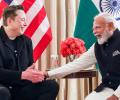
Starlink's application for offering satcom services in India had been held up for the company's inability to comply with mandatory ownership disclosure norms.

India's biggest telecom players, Bharti Airtel and Reliance Industries-backed Jio Platforms, will soon bring billionaire Elon Musk-led SpaceX's Starlink satellite services to India. According to analysts, the move could boost India's tele density, especially in the rural areas, and may be an opportunity for investors to add the two stocks on dips for long-term gains

While the market for satellite broadband currently is small, the potential is large as an estimated 30 per cent of the country does not have reliable terrestrial broadband services.

Discussing the prospect of more reform earlier this month, telecom minister Ashwini Vaishnaw announced a delay in the 5G spectrum auction. India's telecom sector regulation has to be benchmarked with the global best, he said. It's another matter that many countries have either introduced or are about to roll out 5G services that will enable cutting-edge tech in diverse areas. For India, too, it will mean a lot for healthcare, robotics and unleashing a new chapter in Digital India perhaps.
